
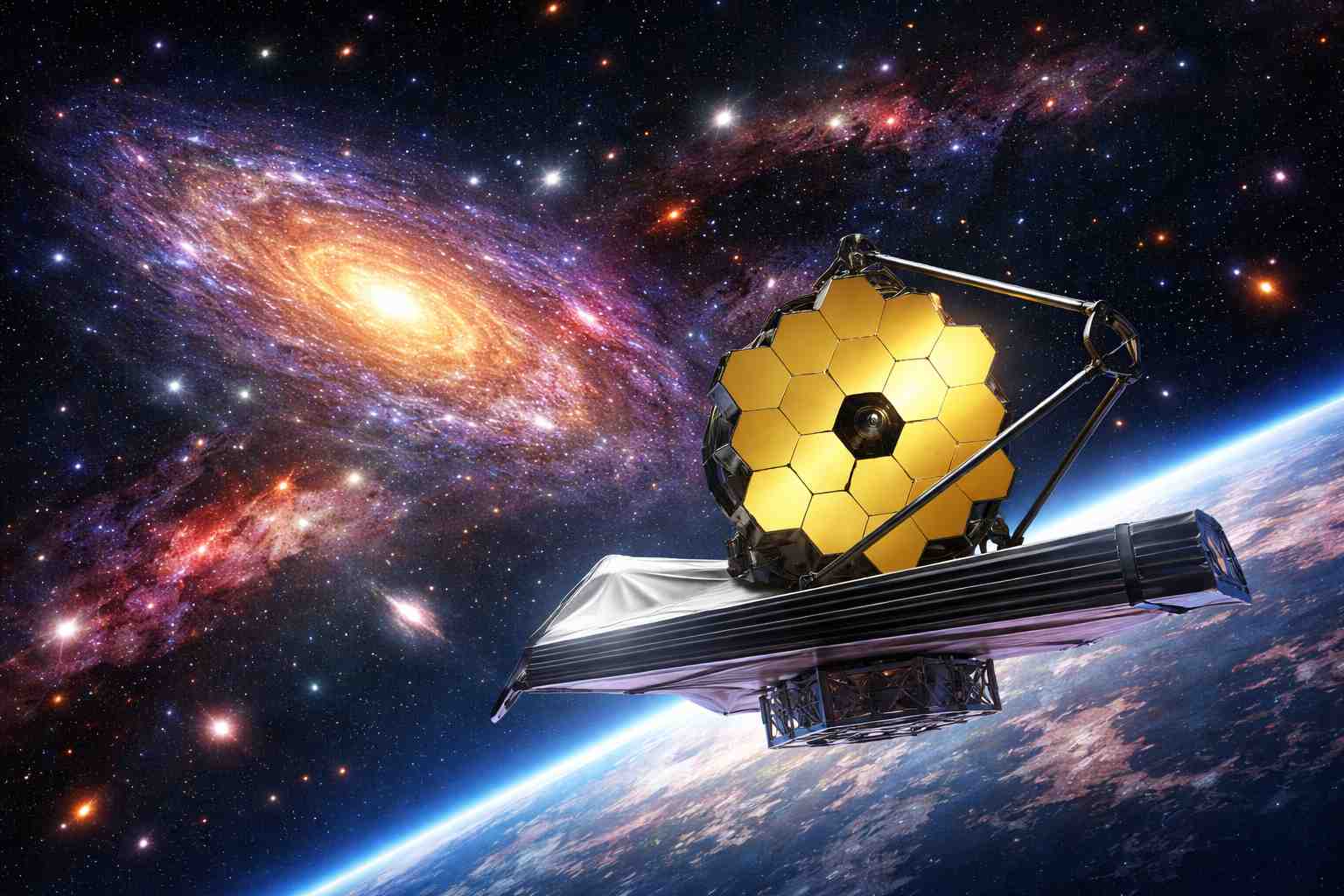
An in-depth look at the most important discoveries made by the James Webb Space Telescope and their impact on modern astronomy.
Introduction: Why the James Webb Space Telescope Matters
The James Webb Space Telescope (JWST) has transformed astronomy in ways scientists once thought would take decades. From observing the earliest galaxies in the universe to analyzing the atmospheres of distant exoplanets, Webb is rewriting what we know about space.
Unlike the Hubble Space Telescope, which observes mainly visible light, the James Webb Space Telescope specializes in infrared astronomy. This allows it to see through cosmic dust, study extremely distant objects, and look back in time to the universe’s earliest moments.
Since its launch, Webb’s discoveries have not just expanded our knowledge—they have challenged long-standing theories about the formation of galaxies, stars, and planets.
How the James Webb Space Telescope Works
The James Webb Space Telescope is the most powerful space observatory ever built.
Key Webb Features
- 6.5-meter gold-coated mirror for capturing faint infrared light
- Infrared instruments (NIRCam, NIRSpec, MIRI)
- Sunshield the size of a tennis court to maintain extreme cold
- Orbit at Lagrange Point L2, nearly 1 million miles from Earth
These features allow Webb to observe objects billions of light-years away with unmatched clarity.
Major James Webb Space Telescope Discoveries
1. Discovery of the Earliest Galaxies
One of the most groundbreaking JWST discoveries is the detection of galaxies formed just 300–500 million years after the Big Bang.
These galaxies appear:
- Brighter than expected
- Larger than predicted
- More chemically evolved
This challenges existing models of early universe formation and suggests galaxies evolved faster than scientists believed.
2. Unprecedented Views of Star Formation
Using infrared imaging, Webb revealed star-forming regions hidden behind thick cosmic dust.
Famous observations include:
- Pillars of Creation
- Carina Nebula
- Tarantula Nebula
These images show stars forming at multiple stages, offering new insight into how stars and planetary systems are born.
3. Exoplanet Atmosphere Discoveries
One of the most searched topics related to JWST is exoplanet discovery, and Webb has delivered.
Webb has detected:
- Water vapor
- Carbon dioxide
- Methane
- Atmospheric clouds
These James Webb exoplanet discoveries mark the first time scientists can study the chemical makeup of distant planets in such detail—an essential step in the search for life beyond Earth.
4. Direct Imaging of Exoplanets
In addition to atmospheric analysis, Webb has captured direct images of exoplanets.
These images allow astronomers to study:
- Planetary temperatures
- Atmospheric composition
- Planet formation processes
This helps scientists compare other planetary systems with our own solar system.
5. Discovery of Organic Molecules in Space
Webb has detected complex organic molecules, including carbon-based compounds, in star-forming regions.
This supports the idea that:
- The building blocks of life are common
- Life-related chemistry may exist throughout the universe
These findings strengthen theories about the cosmic origins of life.
6. Stellar Death and Element Formation
The James Webb Space Telescope has provided detailed images of planetary nebulae, revealing how dying stars release heavy elements into space.
These elements—carbon, oxygen, iron—are essential for:
- Planet formation
- Life as we know it
Webb helps astronomers understand the full life cycle of stars.
7. Black Holes and Galactic Centers
Webb has observed supermassive black holes at the centers of galaxies, including some that formed surprisingly early in cosmic history.
These observations are reshaping theories about:
- Black hole formation
- Galaxy evolution
- The relationship between galaxies and black holes
How James Webb Discoveries Changed Astronomy
Rewriting Cosmic Models
Many JWST discoveries contradict existing theories, forcing astronomers to update models of galaxy and star formation.
Advancing the Search for Life
By analyzing exoplanet atmospheres, Webb has moved the search for alien life from speculation to measurable science.
Inspiring Global Interest
Webb’s images have gone viral worldwide, increasing public interest in space science and astronomy education.
What’s Next for the James Webb Space Telescope?
Future Webb missions will focus on:
- Earth-like exoplanets
- Deeper surveys of the early universe
- Collaboration with telescopes like Euclid and the Roman Space Telescope
Some of Webb’s most important discoveries may still be ahead.
Conclusion: A Telescope That Redefined Astronomy
The James Webb Space Telescope represents one of the most significant scientific achievements of the 21st century.
By revealing ancient galaxies, probing alien atmospheres, and uncovering the chemistry of the cosmos, Webb has changed how we understand the universe—and our place within it.
The age of infrared astronomy has truly begun.