
Learn what a light echo is and how astronomers use it to study stars, supernovae, and distant cosmic events.
The universe is not only vast—it also has a memory. One of the most fascinating ways astronomers glimpse the past is through a phenomenon known as a light echo. Although it sounds complex, a light echo is a beautifully simple idea that helps scientists study powerful cosmic events long after they occur.
In this article, we’ll explain what a light echo is, how it works, and why it is so important for understanding stars, supernovae, and distant regions of space.
What Is a Light Echo?
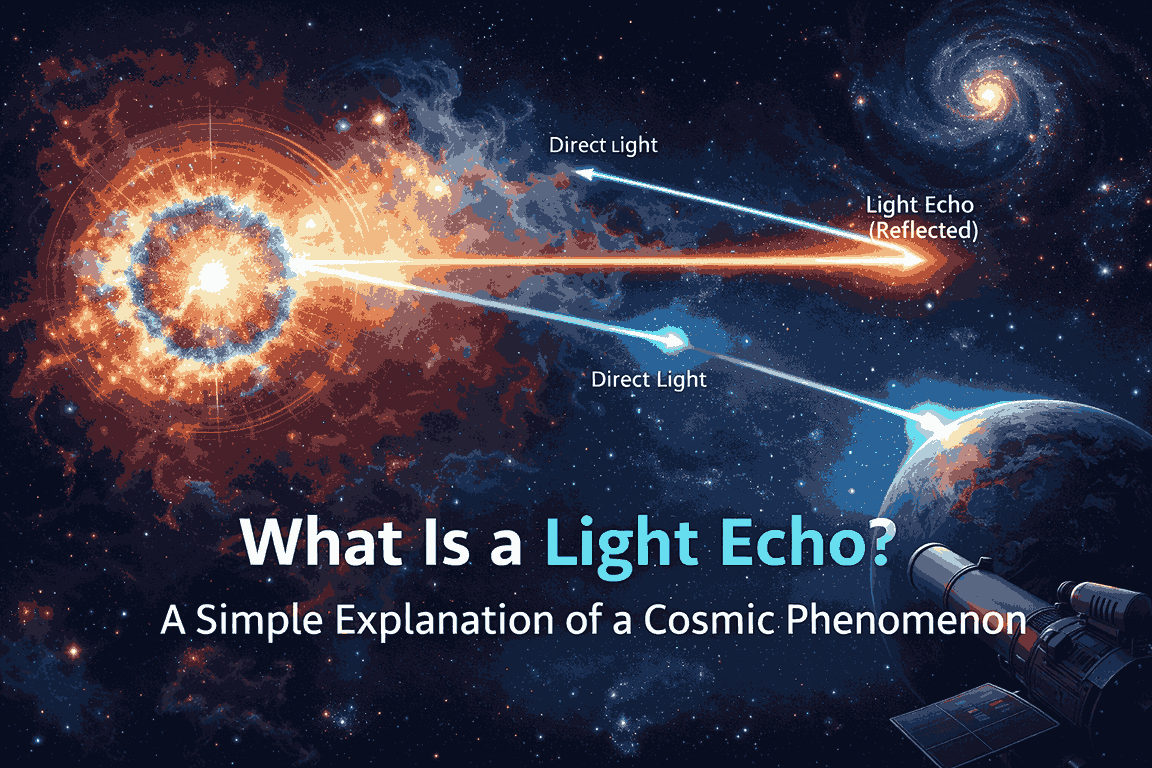
A light echo occurs when light from a bright cosmic event—such as a supernova or stellar eruption—reflects off surrounding dust or gas and reaches Earth later than the original light.
Just like a sound echo reflects off a wall and arrives late, a light echo is a delayed reflection of light traveling through space.
In simple terms:
This delay allows astronomers to observe the same event multiple times from different angles.
How Do Light Echoes Work?
Space is filled with clouds of dust and gas. When a sudden burst of light occurs, such as a supernova explosion, the light spreads outward in all directions.
The process:
Because light travels at a finite speed, these echoes can appear years or even centuries later.
Where Are Light Echoes Found?
Light echoes are rare, but they have been observed in several remarkable places.
Common sources of light echoes:
Some light echoes have even allowed scientists to study supernovae that occurred before modern telescopes existed.
Why Are Light Echoes Important to Astronomy?
Light echoes are more than just a visual phenomenon—they are powerful scientific tools.
What astronomers learn from light echoes:
In some cases, light echoes allow astronomers to reconstruct past events as if they were happening today.
Light Echoes and Supernovae
One of the most exciting uses of light echoes is in the study of supernovae.
Why light echoes matter for supernova research:
Through light echoes, astronomers have studied supernovae that exploded hundreds of years ago—essentially turning space into a cosmic time machine.
Can Light Echoes Let Us See the Past?
In a limited way—yes.
Light echoes do not show everyday scenes from the past, but they preserve information about cosmic events. By analyzing reflected light, scientists can study explosions and stellar changes long after they occur.
This makes light echoes one of the closest real-world examples of observing cosmic history.
Are Light Echoes Still Being Discovered?
Absolutely. With modern telescopes, advanced imaging, and AI-based data analysis, astronomers continue to discover new light echoes.
Future observatories are expected to:
Light echoes remain an active and exciting area of astronomical research.
Conclusion
A light echo is a delayed reflection of light from a powerful cosmic event, bouncing off dust and gas in space before reaching Earth. Though simple in concept, light echoes provide astronomers with a unique window into the universe’s past.
By studying light echoes, scientists can analyze ancient supernovae, understand stellar evolution, and explore the structure of space itself. These cosmic reflections remind us that the universe doesn’t just move forward—it leaves traces of its history behind.
Light echoes are proof that even light can carry memories across the cosmos.