
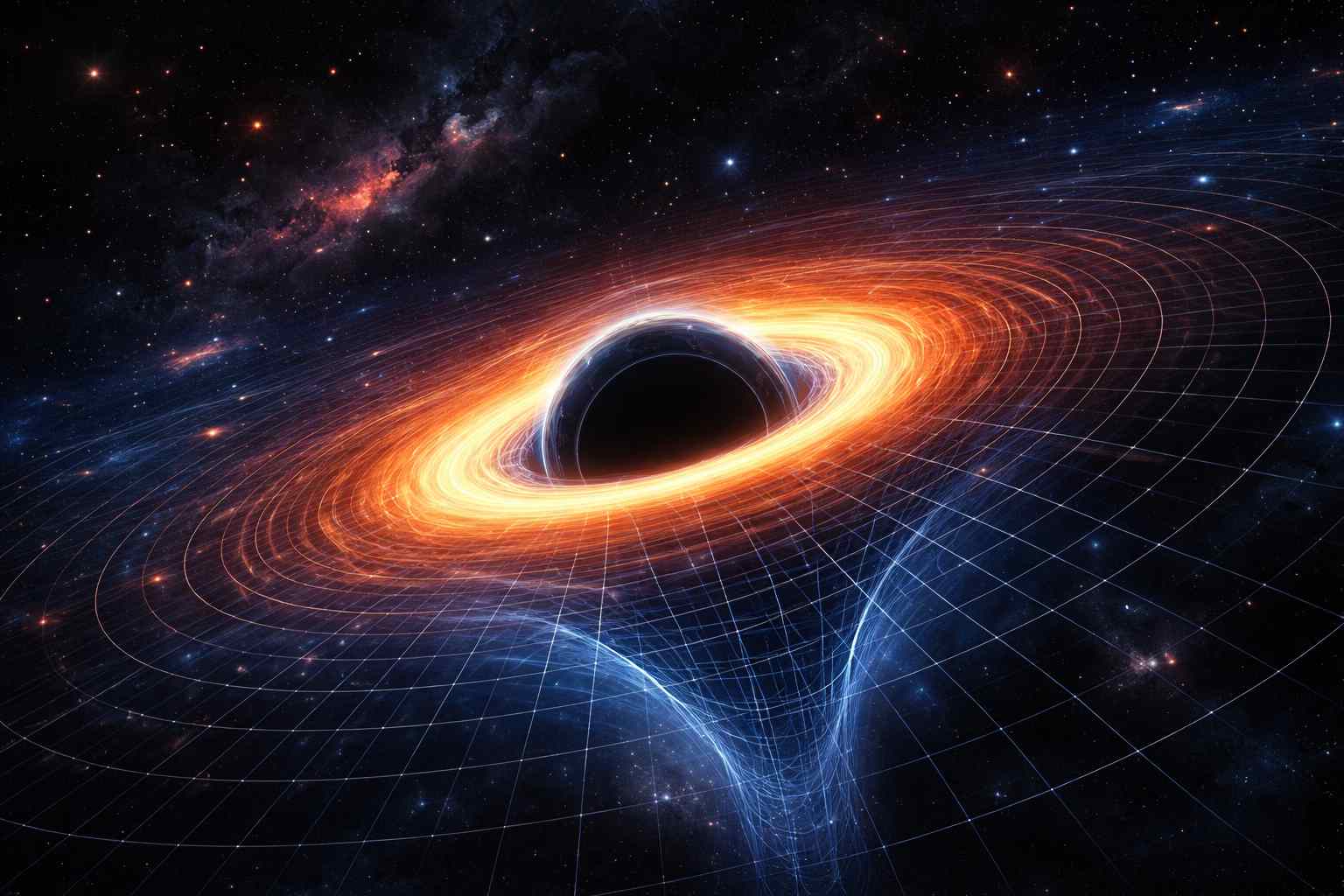
Black holes don’t just swallow stars or light — they reshape reality itself. Near one, distances stretch, clocks slow down, and the universe behaves in ways that feel deeply counterintuitive. What causes this strange behavior isn’t magic or mystery, but physics — specifically, Albert Einstein’s theory of relativity.
Let’s look at how black holes manage to bend both time and space, without diving into complicated equations.
Space and Time Are Part of the Same System
Einstein showed us something revolutionary: space and time are woven together into a single framework called space-time.
Instead of imagining gravity as an invisible pulling force, relativity describes it as a geometric effect. Massive objects change the shape of space-time around them, and everything else simply follows those curves.
A helpful way to picture this:
- A light object barely changes space-time
- A heavy object reshapes it noticeably
- An extremely dense object reshapes it dramatically
Gravity is the result of this reshaping.
Why Black Holes Create Extreme Distortion
Black holes are born when very large stars collapse inward. The star’s mass doesn’t disappear — it gets compressed into an incredibly tiny region called a singularity.
This extreme compression causes:
- Space to curve intensely
- Light paths to bend sharply
- A region where escape becomes impossible
Because no light can leave once it gets too close, black holes appear completely dark.
How Gravity Near a Black Hole Alters Time
Strong gravity doesn’t just affect space — it also affects time itself.
The closer you are to a powerful gravitational source, the slower time passes compared to someone farther away. Near a black hole, this effect becomes extreme.
To someone watching from far away:
- Clocks near the black hole tick more slowly
- Falling objects seem to slow down and fade
To someone falling in:
- Time feels normal
- Nothing unusual happens at the exact boundary
Both perspectives are valid, even though they seem to contradict each other.
The Event Horizon Explained Simply
The event horizon marks the edge of a black hole’s influence.
Crossing this boundary means:
- No return is possible
- No signals can escape
- The outside universe becomes unreachable
It’s not a physical surface, but a limit set by gravity and the speed of light.
What Falling Into a Black Hole Would Do to You
As you approach a black hole, gravity becomes uneven across your body. The side closer to the black hole feels a much stronger pull than the side farther away.
This creates an effect scientists call spaghettification, where objects are stretched lengthwise.
Closer to the center:
- Space and time lose their familiar meaning
- Known physical laws no longer apply
What actually happens beyond that point remains unknown.
Evidence That Black Holes Really Exist
Once considered purely theoretical, black holes are now confirmed through observation. Scientists detect them by watching how they affect their surroundings, including:
- Light bending as it passes nearby
- Stars orbiting unseen massive objects
- Ripples in space-time from black hole mergers
- Direct imaging of a black hole’s shadow
All of these match Einstein’s predictions with remarkable accuracy.
Why Black Holes Are Scientifically Important
Black holes help physicists push theories to their limits. By studying them, scientists can explore:
- How time behaves under extreme gravity
- The true nature of space-time
- Where current physics breaks down
- How the universe is structured
They are among the most powerful tools we have for understanding reality.
Frequently Asked Questions
Does time completely stop near a black hole?
No. Time slows down relative to distant observers, but it never stops for someone experiencing it locally.
Can anything escape a black hole?
Once the event horizon is crossed, escape is impossible.
Could a black hole threaten Earth?
No known black hole is close enough to pose any danger.
What lies at the center of a black hole?
Physics can’t yet describe conditions at the singularity.
Final Thoughts
Black holes bend time and space because they contain gravity in its most extreme form. They reveal that the universe is not rigid or fixed, but flexible and dynamic.
Far from being just cosmic destroyers, black holes are windows into how reality truly works.