
Introduction
In 2026, the world of software is evolving at lightning speed. Businesses and individuals often ask: “What’s the real difference between AI-based software and traditional software?”
Understanding the distinction is crucial for making informed technology choices, whether you are building a new application, automating workflows, or integrating AI into existing systems.
This article breaks down the differences, highlights use cases, and explores how AI is reshaping software development.
1. Traditional Software: Rules and Logic
Traditional software relies on predefined rules and logic. Developers write instructions that the system follows exactly.
Key Characteristics:
- Operates on explicitly coded rules
- Predictable and deterministic
- Handles repetitive, structured tasks
- Requires updates for new functionality
Examples:
- Payroll management systems
- Inventory tracking software
- Banking transaction systems
Pros:
- Reliable for structured processes
- Easier to audit and debug
Cons:
- Cannot adapt to new, unforeseen data
- Limited automation beyond programmed logic
2. AI-Based Software: Learning and Adapting
AI software leverages machine learning, neural networks, and data-driven algorithms to make predictions or decisions. It can adapt to patterns in data rather than relying solely on hard-coded rules.
Key Characteristics:
- Learns from data rather than only logic
- Can make predictions, recognize patterns, and optimize processes
- Continuously improves with new data
- Handles unstructured tasks
Examples:
- Chatbots and virtual assistants
- Fraud detection systems
- Recommendation engines (e.g., Netflix, Amazon)
- Predictive maintenance in manufacturing
Pros:
- Adapts and evolves over time
- Can process large, complex datasets
- Improves efficiency and decision-making
Cons:
- Requires large datasets for training
- Can be opaque (“black box”) and harder to debug
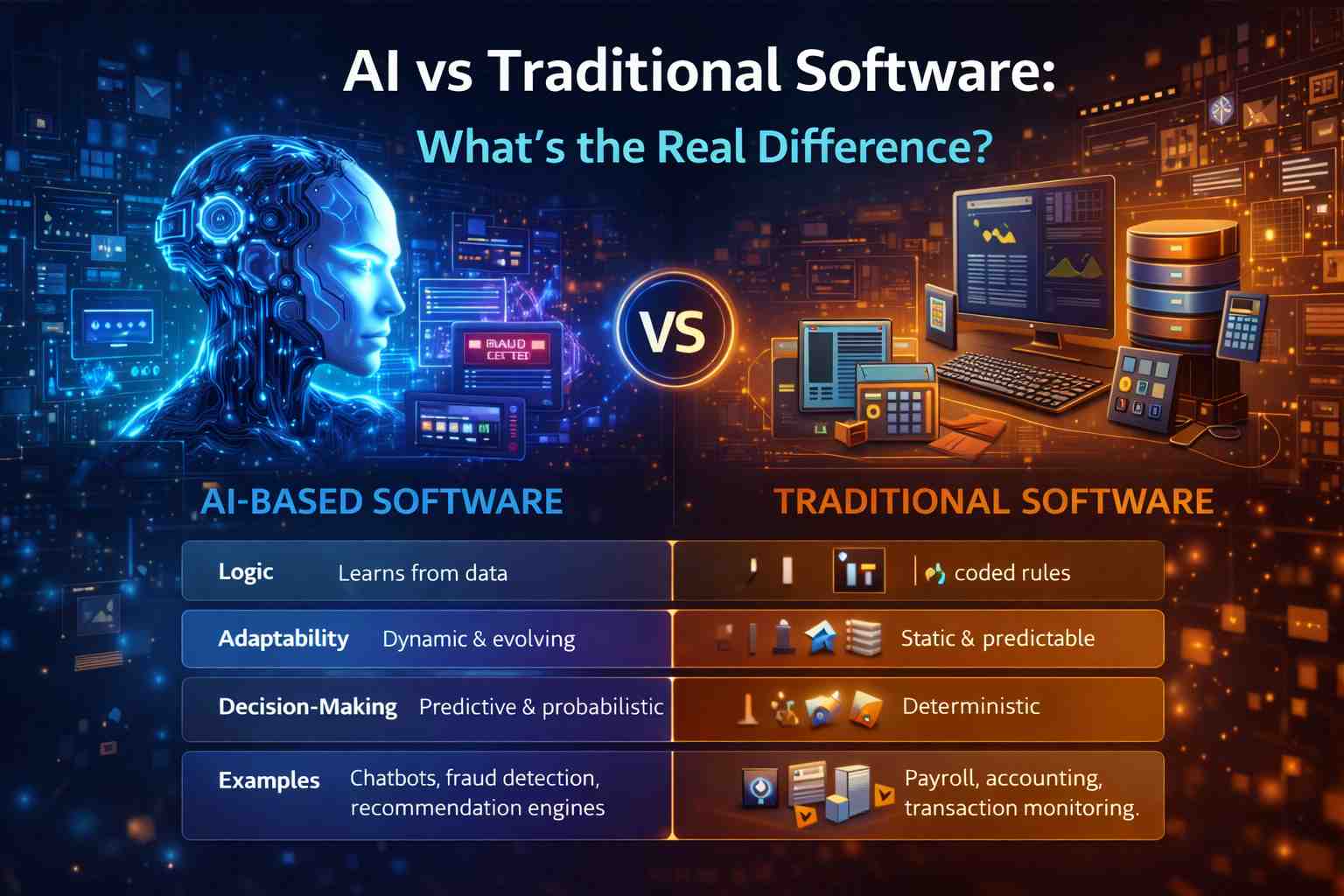
3. Key Differences: AI vs Traditional Software
Logic
- Traditional Software: Explicit rules coded by developers
- AI-Based Software: Learns from data patterns
Flexibility
- Traditional Software: Static; needs updates for changes
- AI-Based Software: Dynamic; adapts automatically
Data Handling
- Traditional Software: Limited to structured input
- AI-Based Software: Handles structured & unstructured data
Decision-Making
- Traditional Software: Deterministic
- AI-Based Software: Probabilistic / predictive
Examples
- Traditional Software: Accounting software, ERP
- AI-Based Software: Chatbots, recommendation engines, predictive analytics
4. Real-World Use Cases in 2026
- Customer Support
- Traditional: FAQ pages, fixed scripts
- AI: Chatbots that understand natural language and resolve queries
2. Healthcare
- Traditional: Patient record systems
- AI: Predictive diagnostics, treatment recommendations
3. Finance
- Traditional: Transaction monitoring
- AI: Fraud detection and credit scoring using predictive algorithms
4. Marketing
- Traditional: Scheduled email campaigns
- AI: Personalized campaigns based on user behavior and engagement
5. When to Use AI vs Traditional Software
- Use traditional software if the process is highly structured, rules are fixed, and outcomes are predictable.
- Use AI-based software if tasks involve prediction, pattern recognition, or optimization, or if your data is large and unstructured.
6. Future Trends in AI and Software Development
- AI-Assisted Development: AI tools are helping developers write, test, and debug code faster.
- Hybrid Systems: Combining traditional rules with AI models for optimal performance.
- Edge AI: Running AI models directly on devices for faster decision-making and privacy.
- Explainable AI (XAI): Improving transparency so decisions made by AI can be understood and trusted.
Conclusion
The line between traditional and AI software is blurring in 2026, but understanding the distinction is key. Traditional software provides stability and predictability, while AI software brings adaptability, predictive power, and automation.
Businesses that combine the reliability of traditional systems with the intelligence of AI are poised to gain the biggest advantage.
By understanding the differences, you can choose the right technology for your problem, implement smarter solutions, and stay ahead in a rapidly evolving digital landscape.