
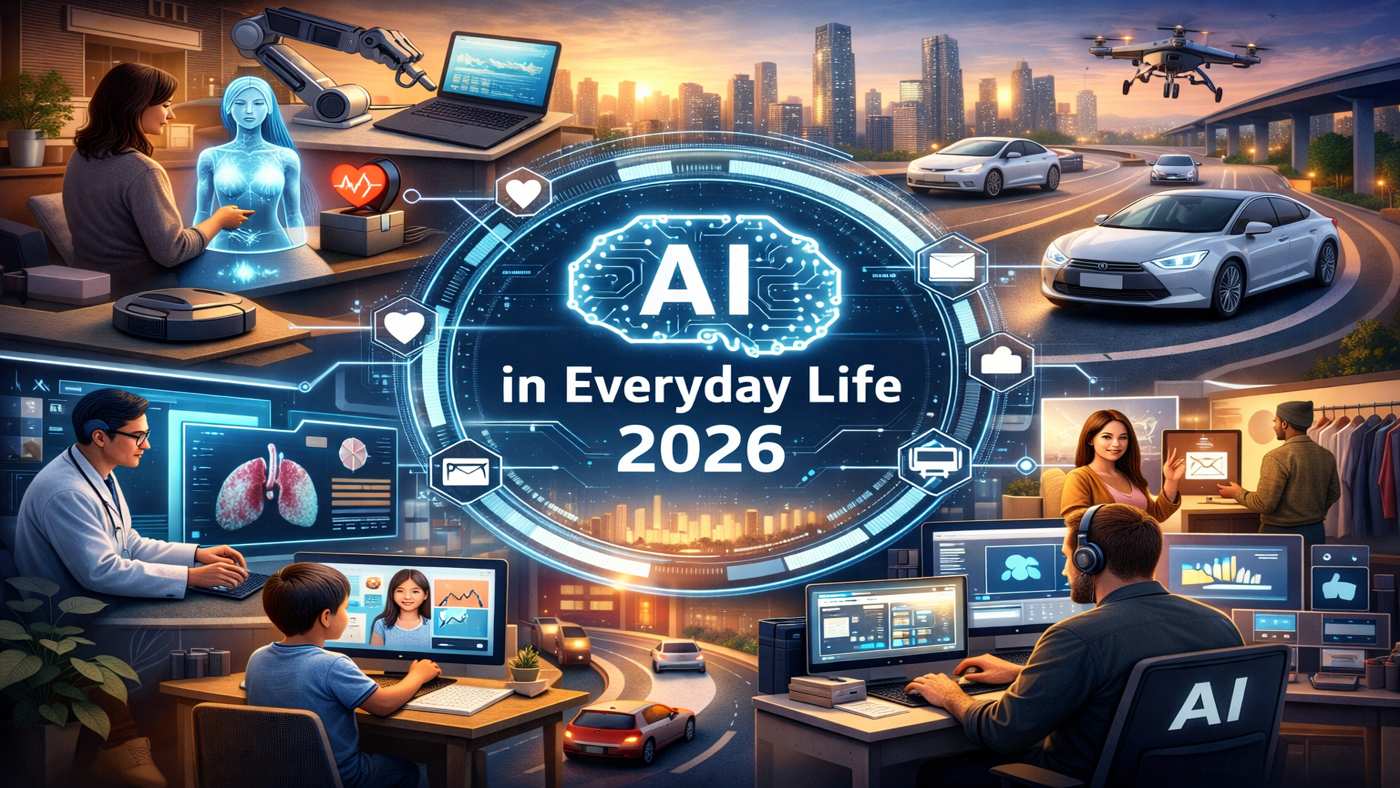
Artificial Intelligence (AI) has moved from being a supporting technology to becoming a core part of everyday life. As we enter 2026, AI is no longer limited to tech companies or research labs—it actively shapes how people live, work, communicate, and make decisions.
From smart homes and virtual assistants to healthcare diagnostics and personalized education, artificial intelligence in 2026 is more intelligent, adaptive, and human-centric than ever before. This article explores how AI is transforming daily life in 2026 and why its impact continues to grow across industries and personal experiences.
1. AI-Powered Personal Assistants and Smart Living
In 2026, AI-powered assistants have evolved into proactive digital companions. They understand user behavior, preferences, and context, enabling smarter automation in everyday life.
Key changes in daily living:
- Smart homes automatically adjust lighting, temperature, and energy usage
- AI assistants manage calendars, finances, and reminders without manual input
- Voice and gesture-based controls are more natural and accurate
These innovations reduce routine effort and allow people to focus on higher-value activities.
2. Artificial Intelligence in the Workplace
AI has become an essential productivity partner in modern workplaces. Rather than replacing jobs, AI tools in 2026 enhance human capabilities.
How AI improves work life:
- Automated report writing and meeting summaries
- Intelligent data analysis for faster decision-making
- AI-assisted coding, testing, and debugging for developers
Organizations use AI to increase efficiency, while employees use it to work smarter—not harder.
3. Personalized Education and Learning with AI
Education in 2026 is more personalized and accessible due to artificial intelligence.
AI-driven learning benefits:
- Adaptive learning paths based on individual progress
- AI tutors available 24/7 for personalized support
- Automated grading and performance analytics
Students learn at their own pace, and educators gain more time for mentoring and creative teaching.
4. AI in Healthcare and Wellness
Healthcare has seen one of the most significant impacts of AI in 2026. Intelligent systems assist doctors, patients, and healthcare providers daily.
Everyday healthcare advancements:
- Early disease detection through AI diagnostics
- Wearable devices powered by AI for real-time health monitoring
- Virtual health assistants for appointment scheduling and symptom analysis
These developments improve accuracy, accessibility, and preventive care for patients.
5. Smarter Shopping and Customer Experiences
Artificial intelligence has transformed how people shop, both online and offline.
AI-powered shopping features:
- Personalized product recommendations
- AI chatbots for instant customer support
- Smart inventory and dynamic pricing systems
Shopping experiences in 2026 are faster, more relevant, and highly personalized.
6. Communication and Content Creation in the AI Era
AI has redefined communication and creativity in 2026.
Everyday AI communication tools:
- AI-assisted email and document writing
- Real-time language translation
- AI-generated images, videos, and marketing content
These tools empower individuals and businesses to create high-quality content with less effort and time.
7. AI in Transportation and Smart Cities
Urban living continues to improve with AI-powered infrastructure.
AI in cities and transport:
- Intelligent traffic management systems
- Predictive maintenance for public infrastructure
- AI-assisted navigation and autonomous vehicle technologies
Cities in 2026 are becoming safer, greener, and more efficient.
8. Ethical AI and Responsible Innovation
With AI deeply embedded in daily life, ethical considerations have become a top priority in 2026.
Key focus areas:
- Data privacy and transparency
- Bias detection and fairness in AI models
- Human oversight and accountability
Governments, organizations, and developers are working together to ensure AI is used responsibly and ethically.
Conclusion
In 2026, artificial intelligence is no longer just a technological advantage—it is a necessity in everyday life. From improving productivity and healthcare to enhancing education, communication, and urban living, AI continues to redefine how people interact with technology.
As AI evolves, its success depends on responsible use, ethical development, and human-centered design. Understanding how artificial intelligence is changing everyday life in 2026 helps individuals and businesses stay informed, adaptable, and prepared for the future.
Artificial intelligence is not replacing humanity—it is amplifying human potential.