
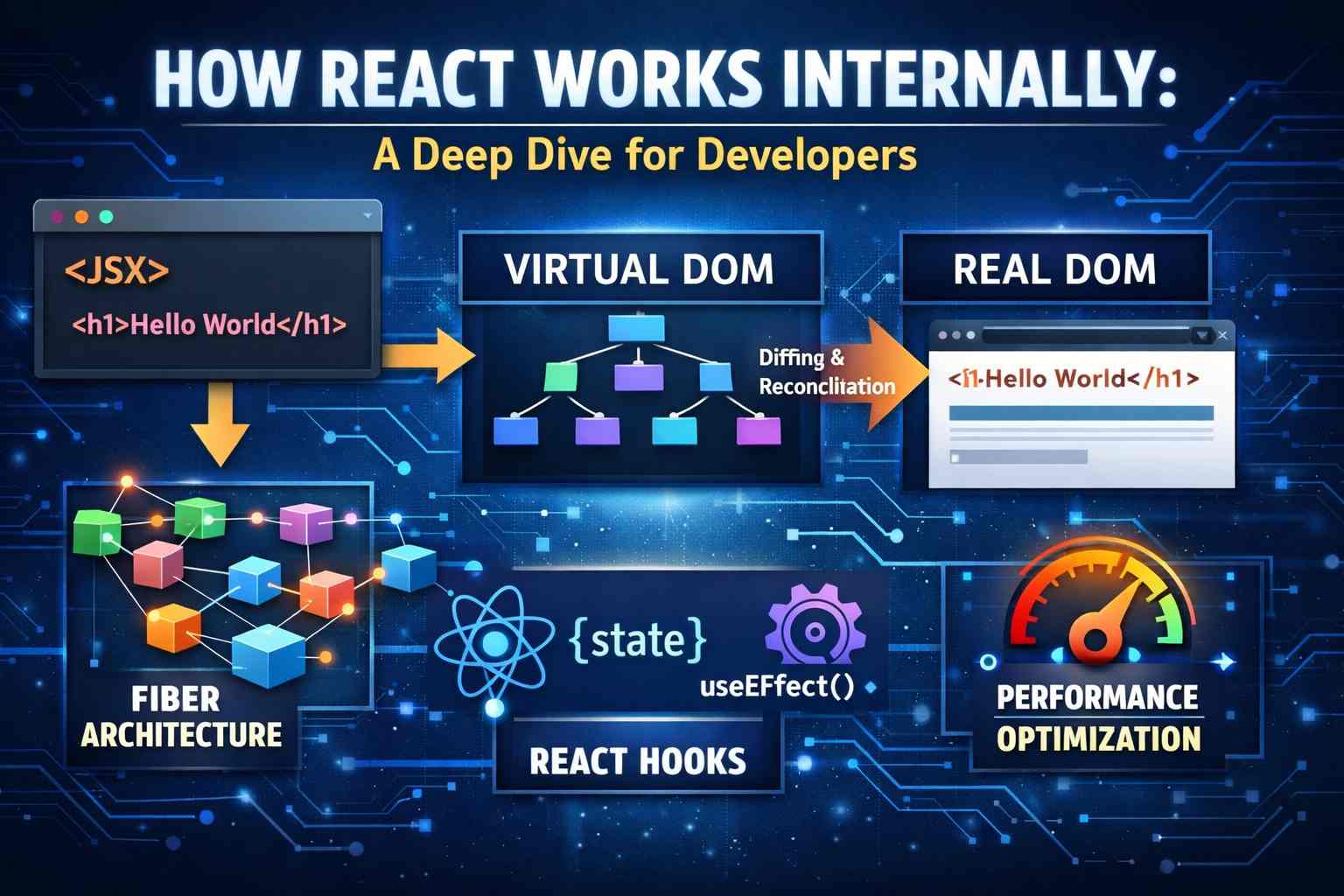
React is one of the most popular JavaScript libraries for building user interfaces. While many developers use React daily, few fully understand what happens behind the scenes. Knowing how React works internally can help you write more efficient, maintainable code, optimize performance, and debug issues effectively.
In this deep dive, we’ll explore React’s inner workings — from JSX and the Virtual DOM to Fiber architecture, reconciliation, hooks, and rendering flow.
What Happens When You Write React Code?
When you write React code, a series of steps occur before anything appears on the screen:
1. SX Compilation:
React converts JSX into JavaScript using Babel. For example:
const element = <h1>Hello World</h1>;
becomes:
const element = React.createElement("h1", null, "Hello World");
2. React Elements:
React elements are plain objects describing what to render in the DOM. They are lightweight and
immutable.
3. Virtual DOM Creation:
React uses a Virtual DOM — a lightweight copy of the real DOM — to efficiently manage updates.
Understanding the Virtual DOM
The Virtual DOM is at the core of React’s performance benefits.
What it is: An in-memory representation of the UI.
How it works: React compares the current Virtual DOM with the previous version to determine changes.
Benefits: Reduces costly direct DOM manipulations, improving performance and responsiveness.
Reconciliation: How React Updates the DOM
Reconciliation is React’s process of updating the real DOM based on Virtual DOM changes.
Key Steps:
- Diffing: React compares the new Virtual DOM tree with the previous one.
- Determining Updates: React figures out which elements need to be updated, added, or removed.
- Applying Changes: Only the minimal set of changes is applied to the real DOM.
This approach ensures efficient rendering, even in complex applications.
React Fiber Architecture
React Fiber, introduced in React 16, is a reimplementation of the React core algorithm to improve responsiveness.
- Incremental Rendering: Fiber allows React to split rendering work into chunks.
- Prioritization: Updates can be prioritized based on importance (e.g., user input vs background tasks).
- Improved Animations: Fiber enables smoother transitions and faster interaction handling.
Components and Hooks Internals
Function vs Class Components
- Class components: Use internal instances and lifecycle methods.
- Function components: Simpler, and with hooks, they manage state and side effects effectively.
How Hooks Work
- useState: Keeps track of state using an internal hooks array.
- useEffect: Registers effects to run after render cycles.
- Re-render triggers: Changing state or props schedules updates via Fiber.
Event Handling in React
React uses Synthetic Events, a cross-browser wrapper around native DOM events.
- Event Delegation: React attaches a single event listener at the root.
- Efficiency: Reduces memory usage and improves performance.
- Consistency: Provides uniform behavior across browsers.
React Rendering Flow
- Initial Render: Creates the initial Virtual DOM tree and commits it to the real DOM.
- Updates: Triggered by state or props changes. React recalculates the Virtual DOM and reconciles.
- Batching: React batches multiple state updates to optimize rendering.
- Commit Phase: Minimal DOM changes are applied efficiently.
Performance Optimization Internals
- Memoization:
React.memo,useMemo, anduseCallbackprevent unnecessary re-renders. - Lazy Loading: Components can be loaded on demand, reducing initial bundle size.
- Concurrent Rendering: React can interrupt low-priority work to keep UI responsive.
Advanced Internals
- Concurrent Mode: Enables React to prepare multiple versions of the UI simultaneously.
- Suspense: Handles asynchronous operations like code splitting and data fetching.
- Server Components: Render components on the server for faster page loads.
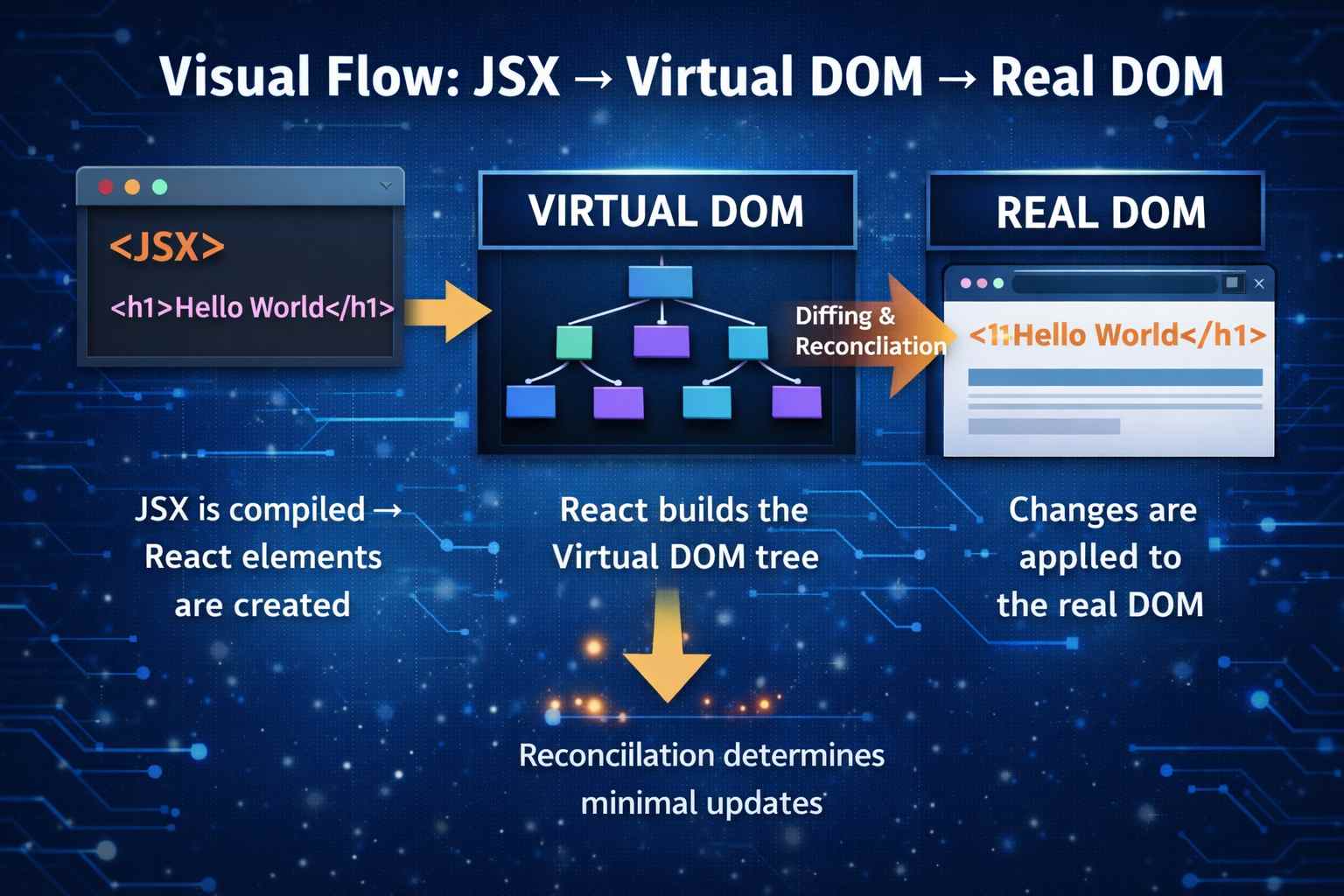
Visual Flow: JSX → Virtual DOM → Real DOM
- JSX is compiled → React elements are created
- React builds the Virtual DOM tree
- Reconciliation determines minimal updates
- Changes are applied to the real DOM
FAQs: React Internals
Is Fiber the same as the Virtual DOM?
No. Fiber is the reimplementation of React’s rendering algorithm, while the Virtual DOM is the in-memory representation of the UI.
How does React decide when to re-render a component?
React re-renders when state or props change, using the Virtual DOM diffing algorithm to minimize updates.
Are Hooks just syntactic sugar?
Not exactly. Hooks manage state and effects internally using React’s hooks array, allowing function components to behave like class components.
How does React optimize performance internally?
Through Virtual DOM diffing, Fiber architecture, batching, memoization, and lazy loading, React ensures minimal and efficient DOM updates.
Can understanding React internals improve my code?
Yes. Knowing React internals helps with performance optimization, debugging, and writing maintainable code.
Conclusion
Understanding how React works internally empowers developers to write better, faster, and more maintainable applications. From JSX compilation and the Virtual DOM to Fiber, reconciliation, hooks, and rendering flow, React’s architecture is designed for performance and scalability.
Mastering React internals is not just academic — it directly improves the quality of your code and helps you make smarter architectural decisions.