
Introduction
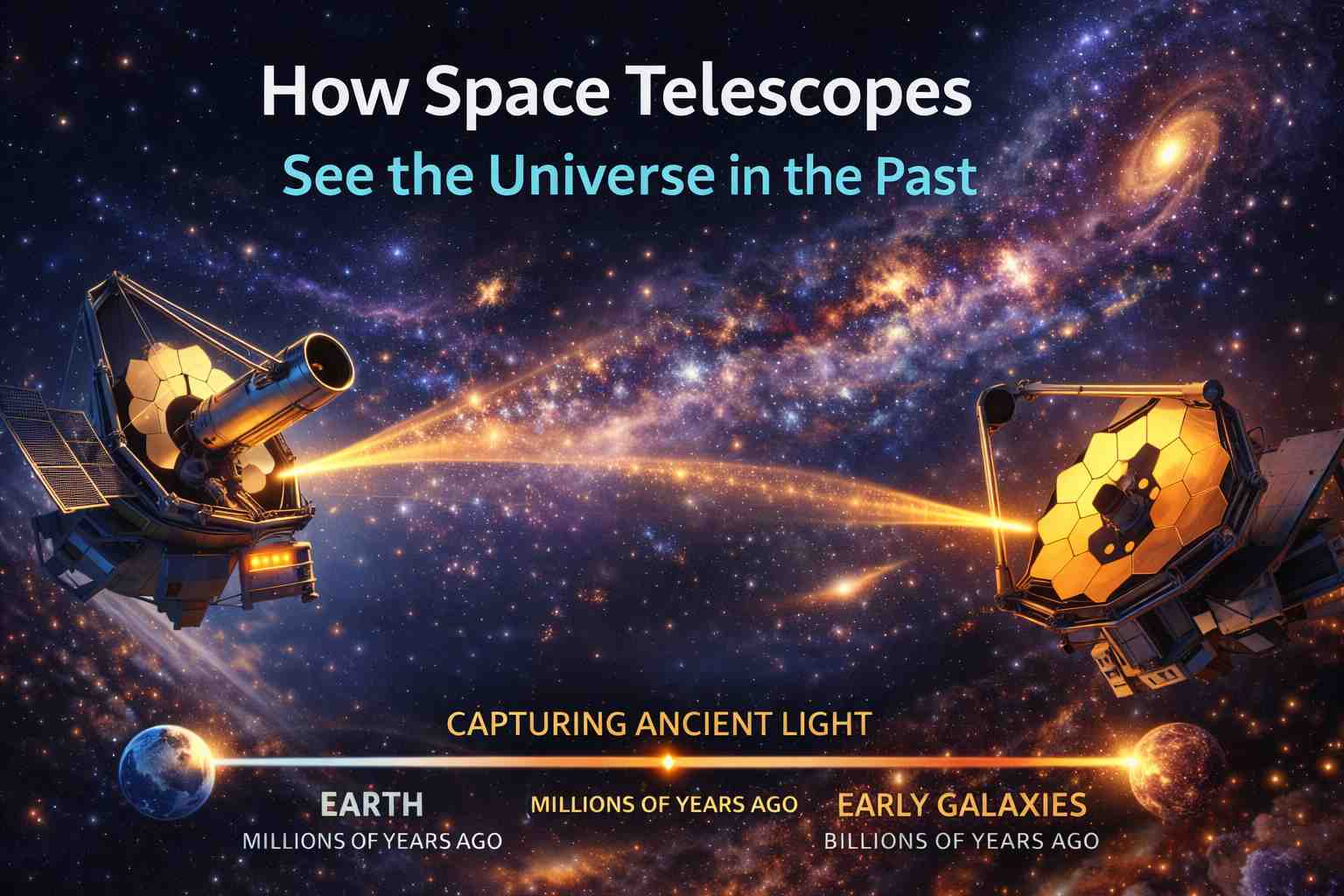
When we look up at the night sky, we aren’t just seeing stars—we’re looking back in time. Thanks to the finite speed of light, space telescopes allow scientists to observe the universe as it existed millions or even billions of years ago.
In this article, you’ll discover how space telescopes capture ancient light, why this lets us see the universe’s past, and how these observations help astronomers understand cosmic history.
Why Looking into Space Means Looking Back in Time
Light travels at a constant speed of about 300,000 kilometers per second. While that sounds fast, the universe is unimaginably vast.
- Light from the Sun takes about 8 minutes to reach Earth
- Light from nearby stars can take years
- Light from distant galaxies can take billions of years
This means when telescopes detect light from distant objects, they’re seeing those objects as they were in the past, not as they are today.
When light from cosmic events travels across vast distances and reaches us much later, it can create fascinating observational effects — such as light echoes, which are delayed reflections of light from dust and gas. Learn more about this intriguing phenomenon in our deep dive on What Is a Light Echo?
What Is Ancient Light?
Ancient light is light that has traveled across space for an extremely long time before reaching us.
Examples:
- Light from nearby galaxies: millions of years old
- Light from early galaxies: billions of years old
- Cosmic Microwave Background: light from shortly after the Big Bang
By studying this ancient light, scientists can reconstruct the universe’s history.
How Space Telescopes Capture Light
Unlike ground-based telescopes, space telescopes operate above Earth’s atmosphere, giving them a clear, uninterrupted view of space.
They capture light in many forms:
- Visible light
- Infrared
- Ultraviolet
- X-rays and gamma rays
Each type of light reveals different information about stars, galaxies, and cosmic events.
Why Space Telescopes Are Better Than Ground Telescopes
Earth’s atmosphere blocks and distorts much of the light from space.
Space telescopes:
- Avoid atmospheric distortion
- Observe wavelengths blocked on Earth
- Capture sharper and deeper images
- Detect faint, distant objects
This makes them ideal for studying the early universe.
Famous Space Telescopes and Their Role
Hubble Space Telescope
- Observes visible and ultraviolet light
- Revealed galaxies billions of years old
- Helped determine the age of the universe
James Webb Space Telescope (JWST)
- Specializes in infrared light
- Sees through cosmic dust
- Observes some of the earliest galaxies ever formed
The James Webb Space Telescope (JWST) allows astronomers to look deeper into space—and further back in time—than ever before by detecting ancient infrared light from early galaxies and star-forming regions.
For a deeper look at how JWST has reshaped modern astronomy, read our detailed article on James Webb Space Telescope discoveries that changed astronomy
Other Space Telescopes
- Chandra (X-rays): studies black holes and supernovae
- Spitzer (Infrared): studied star formation and distant galaxies
How Astronomers Reconstruct Cosmic History
By comparing light from objects at different distances, astronomers can:
- Track galaxy evolution
- Study star birth and death
- Observe supernova explosions
- Understand how the universe expanded
This process is often called cosmic archaeology.
Can Space Telescopes See the Big Bang?
No telescope can see the Big Bang directly, but they can observe its aftermath.
The Cosmic Microwave Background (CMB) is faint radiation left over from the early universe. Studying it gives scientists insight into:
- The universe’s age
- Its early structure
- How matter formed
Why This Matters
Understanding the universe’s past helps answer fundamental questions:
- How did galaxies form?
- Why does the universe look the way it does today?
- What is the fate of the universe?
Space telescopes are essential tools in answering these questions.
Conclusion
Space telescopes act as time machines, allowing us to see the universe as it existed long before Earth formed. By capturing ancient light from distant stars and galaxies, they reveal the story of cosmic evolution.
As telescope technology advances, humanity will continue to look deeper into space—and further back in time—unlocking the secrets of the universe’s origin and future.